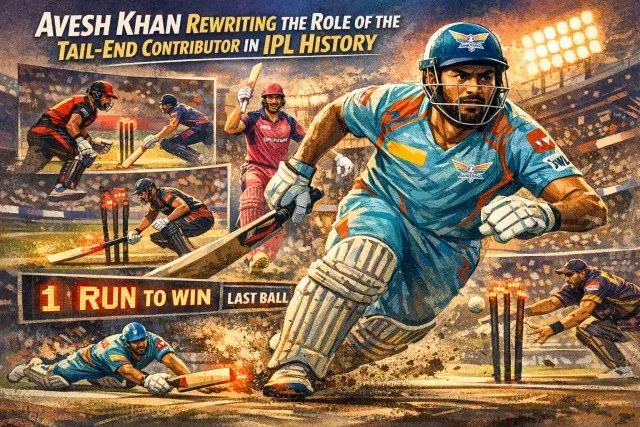

Three times across three editions of the Indian Premier League, Lucknow Super Giants have needed exactly one run off the final delivery to seal a victory. Three times, Avesh Khan has been the man standing at the non-striker's end — calm, composed, and decisive in the act of simply running. It is a pattern unusual enough to deserve scrutiny, and revealing enough to prompt a genuine question about what contribution in high-pressure situations actually looks like.
The Anatomy of Three Near-Identical Finishes
The first instance came during IPL 2023 at the Chinnaswamy Stadium, where Lucknow faced Royal Challengers Bengaluru in a high-scoring encounter. RCB had posted 212 runs, propelled by half-centuries from Virat Kohli, Faf du Plessis, and Glenn Maxwell. Lucknow's chase looked troubled at 23 for 3 before Marcus Stoinis, Nicholas Pooran, and Ayush Badoni steadied the pursuit. On the final delivery, with one run needed, Harshal Patel attempted a Mankad dismissal on Ravi Bishnoi at the non-striker's end — and missed. Avesh Khan, facing the ball, connected with nothing. But a bye carried the ball far enough, and Avesh ran it with the alertness of someone who had been watching the field the entire over. Lucknow won. Avesh scored zero.
The second occasion arrived in IPL 2024 — this time for Rajasthan Royals, the franchise Avesh represented that season. Kolkata Knight Riders had set a target of 223, with Sunil Narine anchoring the innings with a century. Avesh himself had dismissed Phil Salt and Andre Russell with the ball. When it came to the final ball of the chase, Jos Buttler needed a single to win. Buttler played the delivery to the leg side and called for the run. The batters crossed. Avesh had not faced a single delivery in the entire innings. He ran the winning run anyway.
The third episode occurred in IPL 2026, back in Lucknow Super Giants colours, against Kolkata Knight Riders at Eden Gardens. KKR had posted 181 runs, a total that looked manageable but proved complicated for the top order. Mukul Choudhary and Ayush Badoni steadied the pursuit at a critical stage. On the last ball, with one run required, Mukul Choudhary missed the delivery entirely. Avesh Khan, at the non-striker's end, ran. He beat the fielder's throw. Lucknow won by one run. This time, Avesh was credited with a run — one, precisely.
What These Moments Reveal About Pressure and Presence
Each of these finishes depended on a quality that statistical records almost never capture: the readiness to run hard at the exact moment it costs everything to hesitate. In two of the three instances, Avesh did not face a single delivery. His contribution was entirely physical and psychological — the sharp call, the explosive first step, the decision made in a fraction of a second under maximum tension.
This is not a trivial quality. Running between the wickets under pressure, particularly on the final delivery of a high-stakes contest, requires a specific kind of mental clarity. The instinct to freeze — to wait for the ball to settle, to confirm the fielder's position, to check with the other batter — is the instinct that costs runs and costs results. Avesh, in all three situations, did not freeze.
What makes the pattern more striking is its cross-franchise consistency. The 2023 and 2026 instances were for Lucknow Super Giants. The 2024 instance was for Rajasthan Royals. The franchise changed. The role did not. This suggests the quality is intrinsic to the individual, not a product of a particular environment or coaching setup.
The Overlooked Discipline of the Lower-Order Operator
Lower-order contributors in high-pressure finishes are remembered, when they are remembered at all, for boundaries or for improbable half-centuries. The person who survives, runs hard, and gives the genuine batter enough balls to win is rarely afforded the same recognition. This is partly a failure of how performance is narrated and partly a structural bias in how cricketing value is measured — runs scored, wickets taken, strike rates recorded.
Avesh Khan's three appearances at the centre of these finishes represent a category of contribution that is genuinely difficult to replicate. The ability to remain composed when the entire result depends on a single physical action, performed once, with no second attempt available, is a form of competitive temperament that most observers would not think to assign to a specialist with the ball.
His primary value to Lucknow Super Giants across these years has been with his bowling — pace, variation, and the ability to take wickets in the powerplay and at the death. But the three moments described here suggest something else is present: an instinct for the decisive moment that does not restrict itself to any one role. In each case, he was simply the person standing at the other end. Each time, that turned out to be exactly enough.